Muay Thai Vs Boxing: All You Need To Know About Their Effectiveness And Flaws
Contents
- Main Differences Between Muay Thai Vs Boxing
- Muay Thai Stance vs Boxing Stance
- Boxing Vs Muay Thai: Which Is Better For MMA?
- Muay Thai Vs Boxing: Which Would Win In A Street Fight
- Boxing Vs Muay Thai For Self Defense And Fitness: Which Is Better?
- Boxing Or Muay Thai: Which Is Easier To Learn?
- Is Muay Thai More Effective Than Boxing?
- Wrapping Up
- Sources
The Muay Thai vs boxing battle is unending, but really shouldn’t be taken as such.
In MMA, for instance...
You would find it hard to see a nak muay or boxer survive solely on either craft.
But if you're new to both, or just want to pick one up for fitness, it helps to understand how they differ.
So…
I’ll breakdown areas where Muay Thai and boxing stand out. It helps to have an idea of what you’re getting into right off the bat.
It's also natural to wonder how each would hold up in a street fight.
Relax. We’d get to that. 😉
But first, I'll point out a few clear differences.
Main Differences Between Muay Thai Vs Boxing
The main differences between Muay Thai and boxing are:
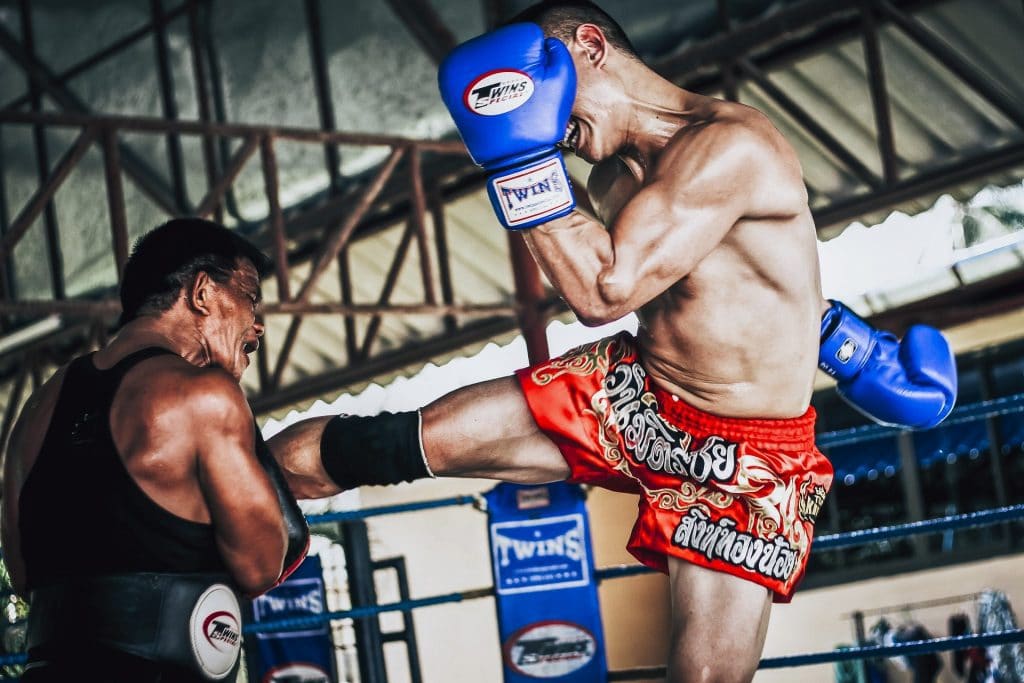
- Muay Thai uses eight limbs to strike (fists, elbows, knees, and shins), whereas boxing uses only the fists
- Muay Thai defense relies more on blocking and checking kicks, whereas boxing trains head movement and footwork in more depth
- Muay Thai uses a squarer, more upright stance, whereas boxing typically uses a bladed, side-on stance
- Muay Thai kicks can be caught or countered with takedowns in MMA, whereas a boxing stance leaves the lead leg open to low kicks
- Top Thai fighters often rack up well over 100 fights from a young age, whereas pro boxers usually have far fewer bouts
- Muay Thai combinations often finish with a kick or knee, whereas boxing combinations are built entirely from punches
Muay Thai Stance vs Boxing Stance
This is perhaps the most significant difference between Muay Thai and boxing.
They both adopt a stance that puts the fighter in a position to move their limbs easily for better defense and offense in their respective crafts.
But which is better?
Muay Thai uses a squarer stance with the hips facing forward. The weight sits more on the back leg, so the front leg can lift quickly to check kicks or throw a teep.
This sets the fighter up to kick, knee, and elbow, and, more importantly, to defend kicks.
Boxing, on the other hand, uses a more bladed stance. The rear foot turns out further and the hips turn so the boxer shows the side of the body rather than the chest and stomach.
This keeps the boxer light on their feet and ready to slip, duck, and move.
In the basic Muay Thai stance, the nak muay (Muay Thai fighter) has less head movement, so he relies on blocking and parrying punches, which can be overwhelming against a skilled boxer.
On the other hand, a boxer's bladed stance and heavy lead leg leave him open to low kicks.
In the fight between the kickboxer and boxer below, you may get a better understanding of what I’m talking about. And right at the beginning of the duel too:
But this is totally different from the reality of a “real fight.” The boxer was restricted (at his own will) and at the mercy of his opponent who took full advantage of the situation.
Boxing Vs Muay Thai: Which Is Better For MMA?
If you are asking to leave one for the other, you'll have a tough time in the MMA. But you probably already know that.
A mixed martial artist would capitalize on the flaws of a “pure” boxer or Muay Thai fighter.
Only a few UFC fighters can kick like Muay Thai pros or punch like pro boxers. MMA rules also make it hard to rely on one style.
For example, a Thai clinch that sets up knees and elbows in Muay Thai can become a takedown opportunity for a good wrestler in MMA.
The point is, you can't totally write off either of them. Learn how to box and have an understanding of kicking as well.
It's left to you to pick one as your base or favorite. As for me, I always advise aspiring pros to go with the better trainer or most equipped gym in their area. A good coach can change everything regardless of which style you decide to specialize in. And a well-equipped gym most times, means they take their craft seriously.
But what about MMA vs boxing? Is there a huge difference? Or maybe even Muay Thai vs BJJ? Which one do you think you'd write off of the three now?
Muay Thai Vs Boxing: Which Would Win In A Street Fight
Street fights are unpredictable. And they surely don’t always go in anyone’s favor regardless of your training.
But let's assume it's a typical fight with two guys standing, unharmed, and ready to pounce on each other. An untrained guy is most likely going to throw a bunch of haymakers.
Boxing teaches you to slip or block wild punches like these and counter.
Muay Thai gives you longer-range weapons. High kicks are risky on a street, but simple kicks like the teep and low kick are easier to use. Still, the safest choice is to avoid the fight and get away.
Check out what happens to the street bully in this video:
Right from the first kick on the calves, to timing his moves, you can tell he’s trained. And low kicks like that one would be bread and butter in a Muay Thai class.
Generally, Muay Thai gives you more weapons at close range, such as knees and elbows in the clinch.
In the end, either art can work. Muay Thai offers more tools, but it usually takes longer to get good at than boxing.
Remember, getting into a fight should be your last option.
Boxing Vs Muay Thai For Self Defense And Fitness: Which Is Better?
If you're looking to use Muay Thai or boxing for self-defense, it's only normal you'd also make your workout routine.
So which one’s better to have a few tricks up your sleeve in real-life situations and help you get a good workout?
Undoubtedly, you'd get a good day's workout with either sport... and also learn practical moves you can use to defend yourself.
Boxing, for one, has one of the most rigorous training routines among sports.
Muay Thai sessions are just as demanding. Harvard Health estimates that 30 minutes of boxing sparring burns about 270 to 380 calories, and 30 minutes of martial arts such as kickboxing about 300 to 420, for people weighing 125 to 185 pounds.
The main difference is that boxing's basics are quicker to learn, so you can get to a useful level sooner.
Boxing Or Muay Thai: Which Is Easier To Learn?
Of all the muay vs boxing debate I’ve heard, this is where we can pick a clear winner.
Boxing is generally easier to learn. You only need to learn how to throw punches, defend punches (with your fists wrapped up with the best boxing hand wraps), and move your feet. In a few months of regular training, you can get solid on the fundamentals.
In many places, boxing coaches are also easier to find than experienced Muay Thai trainers (called kru). Some people travel to Thailand to train Muay Thai for a week or a month.
However, I don't in any way mean that muay is hard to learn. It only has a longer learning curve, as it should, since you'll be learning to use 8 limbs to fight. Besides, boxing being easier to learn doesn't make its training routine any less gruesome.
Is Muay Thai More Effective Than Boxing?
By now, you should understand that its effectiveness depends on the situation. But being a common issue, it’s still worth mentioning.
Under Muay Thai rules, a nak muay has a big advantage over a boxer. The nak muay can kick, knee, and elbow, while the boxer can only punch. Under boxing rules, it's the other way around.
In MMA or a street fight, there's no clear winner. Boxing's footwork and hand speed translate well, and Muay Thai's kicks, knees, and clinch work do too, which is why most MMA fighters train both.
If you are intrigued by the ability to master the striking art of eight limbs and can dedicate the necessary time to learn it, go ahead and train Muay Thai.
Wrapping Up
Decision time:
Which fighting style is better for you, boxing, or Muay Thai?
If you want solid basics quickly, start with boxing. If you want to use your whole body as a weapon, train Muay Thai. Either way, wear a mouthguard and headgear for sparring, since head impacts carry a concussion risk.
Amateur Muay Thai under IFMA rules also requires headgear, shin guards, and elbow guards.
If you want to be a prolific mixed martial artist, you'll have to learn both. But you can take one more seriously as you practice. You'd discover the one you like better as you train.
What's stopping you now?
Go ahead and hit the gym. No excuses! 😉
Sources
- Calories burned in 30 minutes for people of three different weights, Harvard Health Publishing
- Concussion Basics, CDC
- IFMA Rules and Regulations, International Federation of Muaythai Associations